
Steve Moss
Learn how donor-advised funds work, explore their tax benefits, and align your charitable giving with your financial goals.
A donor-advised fund (DAF) lets you take a charitable deduction now and decide which charities to support later. As year-end planning season arrives, it is one of the most flexible tools we recommend to clients who give regularly.
Think of a DAF as a charitable savings account. You contribute cash, stock or other assets to a fund held by a sponsoring organization, such as a community foundation or the charitable arm of a brokerage firm. The sponsor is itself a public charity, so your contribution qualifies for a deduction in the year you make it. From there, you recommend grants to the IRS-qualified charities you care about, on your own timeline.
How a Donor-Advised Fund Works
The process has four steps, and only the first one has a tax deadline:
- Contribute: You give cash, publicly traded stock, mutual fund shares, or certain other assets to your DAF account. The gift is irrevocable once made.
- Deduct: You claim the charitable deduction in the year of the contribution, subject to the usual adjusted gross income (AGI) limits and the new 2026 rules covered below.
- Invest: The sponsor invests the balance in the investment options you choose. Any growth stays in the fund, free of tax.
- Grant: Whenever you are ready, you recommend grants to qualified public charities. That can be next week, next year, or spread over many years.
Opening an account usually takes minutes online, and many sponsors have low or no minimums to start.
Benefit 1: Bunch Several Years of Giving Into One Deduction
For many donors, the biggest advantage of a donor-advised fund is “bunching”: contributing two or three years’ worth of giving in a single year so you itemize that year and take the standard deduction in the others. The charities still receive steady annual support, because you grant it out of the DAF over time.
This matters more than ever. For 2026, the standard deduction is $32,200 for married couples filing jointly and $16,100 for single filers, so many generous households never itemize at all. The One Big Beautiful Bill Act (OBBBA) also added a new floor starting in 2026: itemizers can deduct charitable gifts only to the extent they exceed 0.5% of AGI. Give every year, and you lose that slice every year. Bunch, and you absorb it once.
Here is a simplified example for a married couple with $250,000 of AGI, $20,000 of other itemized deductions (state and local taxes plus mortgage interest), and $15,000 a year of planned giving:
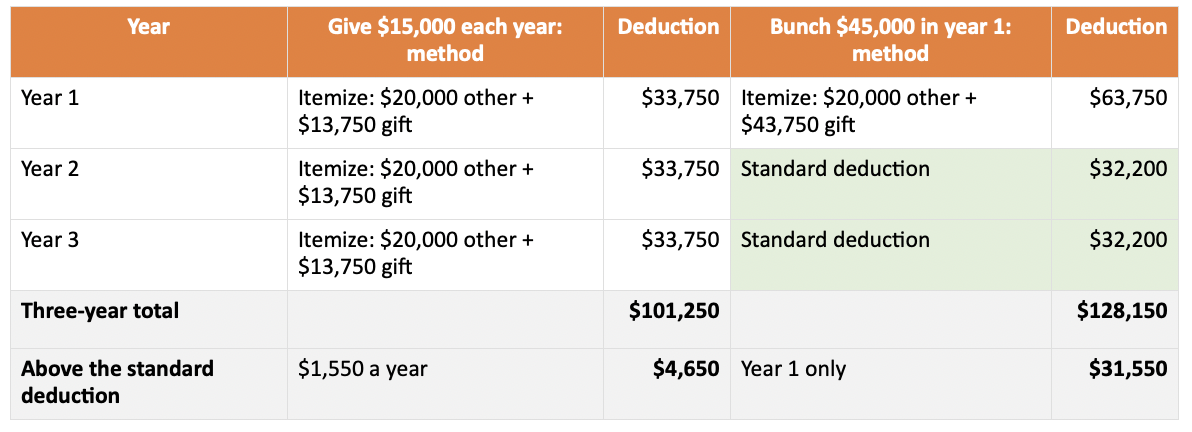
Note: Gift amounts are after the $1,250 floor (0.5% of $250,000 AGI). In years 2 and 3 of the bunching plan, the couple’s $20,000 of other deductions falls below the $32,200 standard deduction, so they take the standard deduction while the DAF makes their usual $15,000 of grants.
Bunching produces about $26,900 more in deductions over three years, worth roughly $6,000 in federal tax savings for a couple in the 22% to 24% brackets. The charities receive the same $45,000 either way.
Two more 2026 rules are worth knowing:
- Cap on top-bracket deductions: Taxpayers in the top 37% bracket now get a maximum 35% tax benefit from itemized deductions.
- No DAF eligibility for non-itemizer deductions: The new above-the-line deduction for non-itemizers ($1,000 single, $2,000 joint) does not apply to gifts made to a donor-advised fund, so smaller donors who will not itemize may be better off giving directly.
Benefit 2: Give Appreciated Stock Instead of Cash
Donating long-term appreciated securities to a donor-advised fund lets you skip the capital gains tax and still deduct the full fair market value. It is often the most tax-efficient asset you can give.
Say you own stock worth $20,000 that you bought for $5,000 more than a year ago. If you sell it and donate the cash, you owe tax on the $15,000 gain: $2,250 at the 15% rate, and more if the 20% rate or the 3.8% net investment income tax applies. If you donate the shares directly, you owe no capital gains tax, the full $20,000 goes to charity, and you deduct $20,000 if you itemize. You can then use the cash you would have donated to buy back the same stock, resetting your cost basis higher.
Many DAF sponsors also accept harder-to-give assets such as restricted stock, private business interests, real estate, and cryptocurrency, then handle the sale. Most small charities are not equipped to do that.
A few limits apply:
- AGI deduction caps: Gifts of appreciated property to a DAF are deductible up to 30% of AGI, versus 60% for cash (any excess carries forward for up to five years).
- Short-term holding rules: Stock held for one year or less is deductible only at cost basis, so donate your long-term holdings first.
Benefit 3: Growth, Simplicity, and a Giving Legacy
Beyond the tax math, a DAF makes giving easier to manage and can increase what ultimately reaches charity.
Key advantages include:
- Tax-free growth: Money in the fund can be invested, and any earnings are not taxed. A $45,000 bunched contribution that grows while you grant it out leaves more for your causes.
- One receipt, cleaner records: You get a single tax receipt for each contribution to the DAF, no matter how many charities you later support. That is far easier at tax time than tracking dozens of acknowledgment letters.
- Time to decide: You can lock in this year’s deduction in December and research where to give in the new year. This is especially useful in a high-income year, such as when you sell a business, exercise stock options, or receive a large bonus.
- Privacy if you want it: Most sponsors let you make grants anonymously, which cuts down on follow-up solicitations.
- A family legacy: You can name successor advisors, such as children, so your giving continues after you. It is a low-cost way to involve the next generation in philanthropy without setting up a private foundation.
What to Watch Out For
A DAF is not the right fit for every gift, and a few rules trip people up:
- The gift is irrevocable: Once you contribute, the money belongs to the sponsor. You advise on grants, but you cannot take it back.
- Fees: Sponsors charge an annual administrative fee, usually a fraction of a percent of the balance, plus the underlying investment costs. Compare sponsors before you open an account.
- No personal benefit: DAF grants cannot pay for gala tickets, memberships with perks, tuition, or anything else that benefits you. They also cannot fulfill a legally binding pledge you made personally, or go to individuals.
- Not for IRA charitable distributions: If you are age 70½ or older, a qualified charitable distribution (QCD) from your IRA can be more valuable than a DAF gift, because it keeps the money out of AGI entirely. However, QCDs cannot be made to a DAF.
- Year-end timing: The deduction counts in the year the sponsor receives your assets. Stock transfers can take a week or more in December, so start early.
Is a Donor-Advised Fund Right for You?
A DAF tends to make the most sense if you give several thousand dollars or more each year, hover near the standard deduction, hold appreciated investments, or expect an unusually high-income year. If your giving is modest and you will not itemize, giving cash directly may let you use the new non-itemizer deduction instead.
The right answer depends on your income, other deductions, and long-term goals. Before year-end, contact us to schedule a tax planning review with our team, and we will model your giving under the 2026 rules, compare bunching against annual giving, and help you decide whether a donor-advised fund fits your plan.
This post is for general information and is not tax or legal advice for your situation. Tax rules change, and individual results vary. Please consult your tax advisor before acting.